 Toyo Drive
Finding a reliable OEM ride-on car supplier in China requires more than comparing catalog prices. Buyers must examine manufacturing experience, product quality, communication, and after-sales support. The right partner should understand children’s safety expectations, battery performance, remote-control systems, and brand customization. A polished website is useful, but it proves very little.
This guide explains how to source OEM ride-on car suppliers through practical checks and informed questions. Start by reviewing factory backgrounds, production photos, export experience, and customer references. Request samples before discussing large orders. Inspect the plastic finish, wheel alignment, wiring, charger labeling, seat strength, and packaging protection. Small details often reveal larger production habits. Ask for quality-control records and relevant testing documentation for your target market. Requirements vary by destination, so independent verification remains important.
Price can mislead.
A low quotation may exclude molds, spare parts, inspections, or safer packaging. A higher quote may reflect better materials, stable battery cells, and trained assembly workers. However, expensive does not always mean reliable. That is where careful comparison matters. Suppliers should provide clear specifications, realistic lead times, warranty terms, and written answers to technical questions. Communication can still break down, especially when product drawings contain unclear measurements. Review every detail before approval. This article will help buyers compare factories, reduce avoidable sourcing risks, and build a more dependable OEM partnership. Some decisions will remain uncertain, but documented evidence makes them easier to manage.
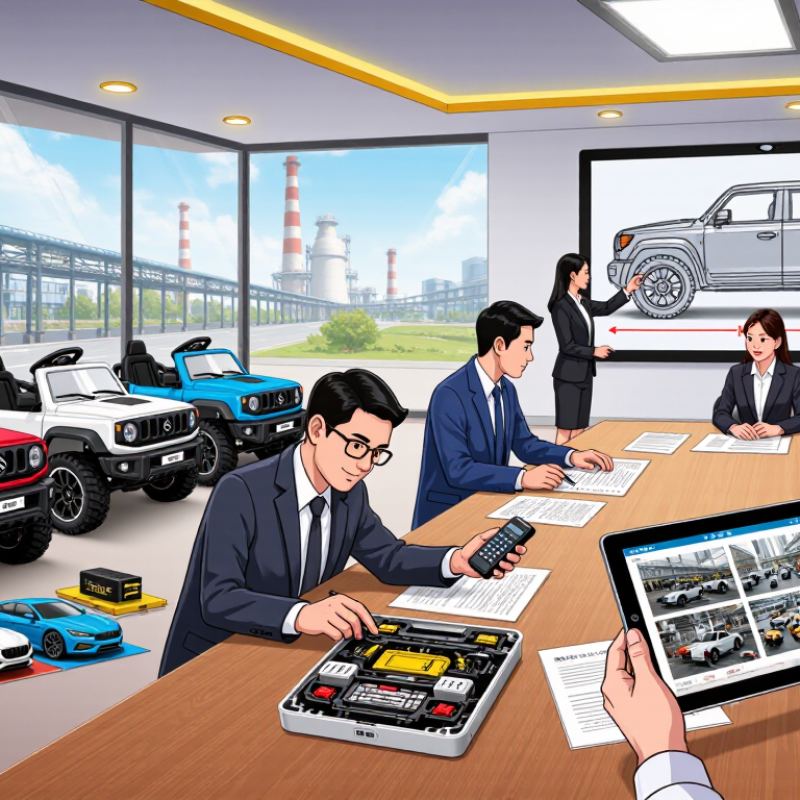
When sourcing OEM ride-on cars in China, voltage is a useful starting point, not a safety classification. A 6V model usually suits younger children, shorter routes, and lower speeds. A 12V model supports heavier loads and outdoor surfaces. A 24V model needs stronger braking, wiring, connectors, and battery protection. The real assessment must include age grading, speed control, charging behavior, plastics, and structural strength.
EN 71 evaluates European toy safety, including mechanical risks, flammability, and migration of certain elements. ASTM F963 is the mandatory U.S. toy safety standard, while GB 6675 applies to toy safety in China. These standards do not simply approve a voltage level. For example, a 24V car can fail because of an accessible gear, unstable seat, or unsafe charger. A 6V car can also fail. Voltage is only one clue.
CPSC’s recent toy injury surveillance reports estimate more than 200,000 emergency-department-treated toy injuries annually in the United States. That figure makes supplier testing more than paperwork. Ask for reports covering EN 71, ASTM F963, and GB 6675, then match each report to the exact model, battery, charger, and production revision. Inspect a sample personally. Check pinch points, belt anchoring, wheel retention, and charging temperature. A laboratory report may look complete, yet the tested sample may differ from mass production. This happens. Build random batch inspections into the OEM agreement.
| Model Voltage | Typical Product Configuration | Common Design Use | Key Mechanical and Physical Safety Checks | EN 71 Mapping | ASTM F963 Mapping | GB 6675 Mapping | Documents to Request from an OEM Supplier | Supplier Evaluation Focus |
|---|---|---|---|---|---|---|---|---|
| 6V |
|
Younger children’s ride-on toy, subject to the manufacturer’s stated age, weight, speed, and supervision requirements. |
|
EN 71-1: Mechanical and physical properties EN 71-2: Flammability of applicable materials EN 71-3: Migration of certain elements from accessible materials |
ASTM F963 requirements should be checked for mechanical and physical hazards, flammability, accessible materials, small parts, and applicable electrical or battery-related hazards. | GB 6675 requirements should be reviewed for mechanical and physical properties, flammability, migration of specific elements, warnings, and applicable toy electrical safety provisions. |
|
Confirm that the supplier can control battery polarity, charging protection, wheel attachment, steering assembly, and small detachable components consistently during mass production. |
| 12V |
|
General outdoor or indoor ride-on toy applications for children within the stated age and maximum user weight. |
|
EN 71-1: Stability, strength, moving parts, warnings, and accessible hazards EN 71-2: Flammability performance EN 71-3: Chemical migration from accessible materials |
Review the current ASTM F963 edition applicable to the destination market, including structural integrity, stability, riding-toy requirements, electric components, batteries, chargers, markings, and instructions. | Review GB 6675 provisions applicable to ride-on toys, including structural safety, accessible materials, warnings, instructions, and battery or charger-related risks. |
|
Verify that the test sample, firmware or control logic, remote control, charger, battery pack, wheels, and decorative materials are identical to the production version. |
| 24V |
|
Larger ride-on toy configurations; suitability must be determined from the declared age grade, maximum speed, user weight, and intended surface. |
|
EN 71-1, EN 71-2, and EN 71-3 remain relevant where the product falls within the applicable toy scope. Voltage alone does not determine compliance; the complete design and intended age grade must be assessed. | ASTM F963 applicability should be confirmed for the complete ride-on toy, including electrical systems, batteries, chargers, stability, structural integrity, warnings, and foreseeable misuse. | GB 6675 applicability should be confirmed for the complete product, with particular attention to mechanical strength, stability, electrical safety, battery charging, warnings, and instructions. |
|
Choose a supplier able to demonstrate engineering validation, safety-critical component traceability, controlled software or remote-control changes, and repeatable production testing—not only a single laboratory report. |
| All voltage classes | Any 6V, 12V, or 24V ride-on car with a motor, rechargeable battery, charger, remote control, decorative lighting, or electronic sound module. | The final age grade, maximum child weight, maximum speed, riding environment, and supervision requirements should be defined before compliance testing. |
|
EN 71 is a series of European toy-safety standards. The applicable parts depend on the product design, materials, intended use, and market requirements. A supplier should identify the exact edition and test scope. | ASTM F963 is a United States toy-safety standard. The applicable requirements depend on the product’s intended use and configuration, and should be verified against the current regulatory requirements for the target market. | GB 6675 is China’s toy-safety standard series. The applicable requirements should be confirmed according to the product type, age grade, materials, electrical features, and intended market. |
|
Prefer suppliers that provide transparent test scope, consistent model identification, controlled revisions, documented incoming inspection, final inspection, and pre-shipment verification. |
Request recent purchase orders, dated production schedules, and shipping records with sensitive details removed. Compare quoted output with weekly line capacity. A factory may quote 300 units but produce only 80 weekly. Evidence matters more than attractive photos.
Measure lead time from deposit to finished goods. Ask for the longest delay during the past twelve months. One delayed component once added 18 days to my plan. Average figures can mislead.
Ask whether colors, battery types, packaging, or custom tooling change the minimum order. Record every condition in your supplier scorecard. Small changes matter.
Include minimum order quantity, monthly output, sample time, production lead time, and delivery performance. Add dated work-in-progress photos and capacity reservations. Leave a small schedule buffer. Records can still be incomplete.
Request a line-by-line list for motors, battery cells, plastics, chargers, tires, fasteners, and packaging. Match each item with a drawing or approved sample. Record the bill-of-materials version in the purchase file. Hidden substitutions can create warranty costs.
Confirm cavity count, steel grade, expected shots, maintenance duties, ownership, and removal terms. Request dated mold photos and trial-run measurements. For freight, check carton size, gross weight, loading quantity, and port charges. I once underestimated mold maintenance.
Request inspection reports, batch records, sample sizes, and corrective-action reports. Separate cosmetic defects from brake, steering, battery, and charger failures. A percentage without a denominator proves little. Use an agreed defect classification and inspect pre-shipment samples.
Test battery endurance, charging time, remote response, steering stability, and plastic finishing. Record results with photos and test dates. Request a second unit from regular production. One polished sample proves little.
Inspect assembly lines, incoming-material checks, final testing, worker training, and defect records. Ask for recent records, not prepared displays. Verify certificates against the exact model, market, factory address, and validity period. Paperwork alone is not proof.
Request warranty-claim rates, replacement-part response time, first-response hours, and recurring-defect data. Set targets for replies and approved-part shipment. Confirm who pays for verified manufacturing faults. A supplier may promise support but lack spare motors or controllers.
Finding reliable OEM ride-on car suppliers in China requires a structured evaluation rather than relying on price alone. This guide explains how to source OEM ride-on car suppliers by matching 6V, 12V, and 24V models with applicable EN 71, ASTM F963, and GB 6675 requirements. Buyers should verify supplier records for minimum order quantities, monthly production capacity, and realistic lead times, while auditing battery specifications, charger performance, speed limits, and load data against relevant safety standards.
A complete comparison should also include bill of materials, tooling charges, freight costs, Incoterms, and documented defect-rate evidence. Before placing an order, assess product samples, factory audit results, certification validity, and after-sales performance indicators. By scoring suppliers across technical compliance, manufacturing capability, cost transparency, quality consistency, and service responsiveness, importers can reduce supply risks and select a dependable partner for long-term OEM cooperation.
